Love > Fear: A Phoenix Protest Reflection

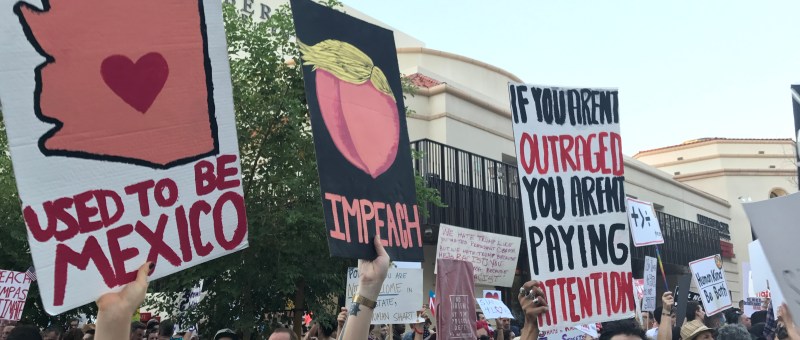
Donald Trump came to town last night. I decided to head downtown to physically stand up to a person that I disagree with wholeheartedly. I knew I wasn’t going to be the only person in downtown, but I was not prepared for the large crowd of protestors President Trump would be attracting in Phoenix.

Some of the protest signs were hilarious: “you can’t comb over racism,” “Impeach Trump,” and “I still can’t believe I have to protest this s**t” held by an older woman were some of my personal favorites. I was also pleasantly surprised by the number of signs saying something along the lines of “Love Trumps Hate,” “We choose love,” etc.

It was a strange juxtaposition when those same people holding the love signs were yelling “SHAME ON YOU” or just “Shame” to those walking into the rally.

There is a Mother Teresa quote that says, “If we have no peace, it is because we have forgotten that we belong to each other.” As I was watching the crowd on both sides, it was clear we had forgotten we belong to each other. I can only equate my experience to a sporting event. There is the winning team & the losing team. As the crowd of protestors was chanting “shame on you,” the people walking into the Trump rally LOVED it. I could just imagine them saying “The snowflakes are so triggered.” They would respond to the crowd by waving, a few would record themselves flipping off the protestors, and others would blow kisses like this was some strange game.

Throughout the night I became more and more frustrated with the crowd on the protest side. All we did was prove the point the right-wing media has been saying since the election, that we were just some “triggered snowflakes.” I struggled with what could have been. What if we all were standing there with our signs completely silent. What if we were singing “Why Can’t We Be Friends” or “All You Need is Love.” What if we tried to reach across the aisle and talk to people. All the shouting was no more effective in Phoenix then it was in Game of Thrones when Cersei walked through Kings Landing.


As the #Resistance grows and protests continue, we need to be organized. The chants must change. We have to sit down with people over a meal, rather than yell at them over the fence. This is not a game. As Americans, we share a common goal, that “All men (and women, or other non-binary people) are created equal.” It should not matter whether we are pro-Trump, anti-Trump, couldn’t give a f**k about Trump, we need to treat each other with respect and love that is deserved by our common humanity.

As the Trump era continues, I hope that we can remember this wisdom found within the Christian tradition of faith, John 4:18: “There is no fear in love, but perfect love casts out fear; for fear has to do with punishment, and whoever fears has not reached perfection in love.”

Let us not be afraid of the “other” among us. Learn from each other. Love each other.

Love>Fear


The What of Stress

Lesson for Dayspring Youth Ministries on September, 13th 2015. Not to be reused without permission.

Stress: What, who, why, how

Goal: YWBAT understand the “What” of stress. What can cause stress, and what does stress feel like.

Materials Needed: What slide show, computer, projector, speakers, power chord, any game materials.

What? Ask youth the questions. Record their answer on white board or other device.

  1. What is stress?
    1. a state of mental or emotional strain or tension resulting from adverse or very demanding circumstances.
  2. What stresses you out?
    1. School, parents, friends, expectations, society, etc.
  3. Anything else?
  4. Is all stress bad?

Activity

Instructions: Number youth off from 1-2. Separate them into groups. Have each group choose two volunteers to be the groups test subjects.

  • Group 1: Negative Stressors-
    • Group members will function as negative stressors on their test subjects. Negative comments, unhelpful suggestions, general distractions, etc.
  • Group 2: Positive Stressors-
    • Group members will function as positive stressors in what ever way they think is appropriate, encouragement, compliments, helpful hands.

Set up “obstacle course” of stress. Obstacle course to be completed as fast as possible. 

  1. Physical stressors: Suicides in large open area. Set boundary before hand. 10 push ups. 10 jumping jacks.
  2. Mental stressors: Complete math problems on the white board.
  3. Problems: 4×4, 38/6, 2x+17= 0
  4. Board Game: Operation remove two pieces. If you hit buzzer you have to start over completely.
  5. Societal Stressors: “You’re Outfit Of the Day didn’t get enough likes on instagram” change it to get more likes

Have group 1 test subjects complete course. Group mates should function as negative stressors as indicated above. During this time Group 2 should be observing both test subjects and group mates, taking notes about their observations.

Have group 2 test subjects complete course. Group mates should function as negative stressors as indicated above. During this time Group 1 should be observing both test subjects and group mates, taking notes about their observations.

For additional stress: have music in the background. For group 1, play angry music (death metal, hardcore rap, etc). For group 2 play friendly happy music.

Debrief: Return to large group. Discuss the activity.

Encourage youth to discuss every part of this activity. What did it feel like to be a test subject. A group mate. What did you notice when you were observing the activity.

Make sure to list the signs of stress that youth were able to notice. Review what was discussed. End lesson with Highlights and bummers.

Stress- %22What%22 ppt

Music In Worship

Music in Worship is at a crossroads, and has been for sometime. In music history I wrote research paper on the writings of Martin Luther, and his views on music in worship. Below are some solutions I put forth. I invite your thoughts.

There is no good answer to the issues facing music in worship today. Both common performance mediums (Traditional and Contemporary Styles) have their positives and negatives. Some of these issues could be solved by a comprehensive music education for all people, but in the Untied States, that simply won’t happen for the time being. What is a solution to this issue that clergy could implement right now?

  1. Do not be afraid to teach the music to the congregation. If the melody is taught by rote, four measures at a time, it allows the congregation to get the pitch changes, and also spend more time with the lyrics and message of the song. If led by the clergy of the church, this can also provide a different type of connection to the members of the congregation, then can be found from preaching behind the pulpit.
  2. Offer classes. Many churches already offer out of service classes about many topics of spiritual importance.Why shouldn’t music be one of them? Offering classes on how to read hymns, or music in general would create a ministry opportunity that hasn’t been seen before. This can provide an entirely different ministry that is lacking from almost all churches, can help prevent people from being alienated by the hymn book, and allow clergy to connect to an entirely different group of congregants. (It might even help recruit people for the choir. 
  3. Ask your congregation. The type of music that they like is important in order for them to connect to the music. Ask the congregation the type of music they prefer and see if you can incorporate this into the musical worship.
  4. Use accompaniment appropriate for the song. Do not be afraid to use a guitar for one song, an organ for another, or a flute for the next. A great example of this would be to compare to songs that are popular in my own church.
    1. The first hymn,“O’ For a Thousand Tongues” by Charles Wesley, was written to be accompanied by Organ or Piano, so using this accompaniment would be appropriate to the context it was written. 
    2. The second hymn, “Shine Jesus Shine” was written for a praise band accompaniment, so using the church organ to accompany this song would not be appropriate. In this case, leading the congregation with a guitar or jazz piano would make much more sense.
  1. Make it fun. In his letter to the Church at Wittenberg, Luther writes  “… taking care lest the people should either be bored by too much repetition.” Luther wants the congregation to be interested in the music. Part of the way he made this happen was to include many types of music in his services. By making the music fun and enjoyable for the congregation to sing, the chances for congregants to connect to the spirituality of the song improves exponentially.

Conclusion

One of the key points of the reformation, started by Luther, is that there should be no secret to spiritual connection. This connection is for all people, not just the rich or the clergy. Music helps to create this connection and should be encouraged in all settings of worship. In Luther’s favorite scripture, Psalm 96, it states to “Sing unto the lord a new song. All the Earth.” It is far past time that music in worship started to sing a new song. A song that encourages all people in worship to sing along, not just the trained musicians. How that happens will have to be decided at each congregation. I hope that in my own church congregation we can begin to expand the congregational music making, and help people connect to the spirit they are called to. 

Music In Worship

Music in Worship is at a crossroads, and has been for sometime. In music history I wrote research paper on the writings of Martin Luther, and his views on music in worship. Below are some solutions I put forth. I invite your thoughts.

There is no good answer to the issues facing music in worship today. Both common performance mediums (Traditional and Contemporary Styles) have their positives and negatives. Some of these issues could be solved by a comprehensive music education for all people, but in the Untied States, that simply won’t happen for the time being. What is a solution to this issue that clergy could implement right now?

  1. Do not be afraid to teach the music to the congregation. If the melody is taught by rote, four measures at a time, it allows the congregation to get the pitch changes, and also spend more time with the lyrics and message of the song. If led by the clergy of the church, this can also provide a different type of connection to the members of the congregation, then can be found from preaching behind the pulpit.
  2. Offer classes. Many churches already offer out of service classes about many topics of spiritual importance.Why shouldn’t music be one of them? Offering classes on how to read hymns, or music in general would create a ministry opportunity that hasn’t been seen before. This can provide an entirely different ministry that is lacking from almost all churches, can help prevent people from being alienated by the hymn book, and allow clergy to connect to an entirely different group of congregants. (It might even help recruit people for the choir. 
  3. Ask your congregation. The type of music that they like is important in order for them to connect to the music. Ask the congregation the type of music they prefer and see if you can incorporate this into the musical worship.
  4. Use accompaniment appropriate for the song. Do not be afraid to use a guitar for one song, an organ for another, or a flute for the next. A great example of this would be to compare to songs that are popular in my own church.
    1. The first hymn,“O’ For a Thousand Tongues” by Charles Wesley, was written to be accompanied by Organ or Piano, so using this accompaniment would be appropriate to the context it was written. 
    2. The second hymn, “Shine Jesus Shine” was written for a praise band accompaniment, so using the church organ to accompany this song would not be appropriate. In this case, leading the congregation with a guitar or jazz piano would make much more sense.
  1. Make it fun. In his letter to the Church at Wittenberg, Luther writes  “… taking care lest the people should either be bored by too much repetition.” Luther wants the congregation to be interested in the music. Part of the way he made this happen was to include many types of music in his services. By making the music fun and enjoyable for the congregation to sing, the chances for congregants to connect to the spirituality of the song improves exponentially.

Conclusion

One of the key points of the reformation, started by Luther, is that there should be no secret to spiritual connection. This connection is for all people, not just the rich or the clergy. Music helps to create this connection and should be encouraged in all settings of worship. In Luther’s favorite scripture, Psalm 96, it states to “Sing unto the lord a new song. All the Earth.” It is far past time that music in worship started to sing a new song. A song that encourages all people in worship to sing along, not just the trained musicians. How that happens will have to be decided at each congregation. I hope that in my own church congregation we can begin to expand the congregational music making, and help people connect to the spirit they are called to.