

Aural Skills
Your Initial Ideas:
After reflecting on my beginning music instruction, I realized that aural skills were entirely ignored until I reached a high school band. My first instrument choice in 5th grade was percussion. Typical of all beginning band, percussionist were placed in the back and left to fend for ourselves. I had helpful instruction from my beginning band teacher when it came to rhythms and general rudiments on snare drum. For mallet skills, I was given a book, and since I had taken piano I was able to decipher the notes and rhythms on my own. This ability had me at the top of my class for percussion. I didn’t realize until junior high though, that I did not have any sort of musical ear. I was told to tune a timpani and I found this an impossible task. I could not hear these notes. It wasn’t until now that I was able to figure out why, I was not required to use my ear to create/figure out notes. It is because of this realization that I find aural skill development from the beginning very, very important. Other teachers that I have worked with agree with me on this topic, because the ability to hear and sing a pitch is fundamental to music making.
The Voice of Authority:
In the article by Peggy D. Bennett, she discusses the importance of teaching children to discover their voices. The author is an instrumentalist, but states that she uses a vocal approach to teaching music to her students. Her approach to expression through the voice can become a channel to teaching musical expression on the instrument through similar strategies. It is one way to develop the skill of creating the sounds heard in the head, into the sounds heard in a musical performance. In another article, by Bruce Dalby, he discusses the methods introduced by Edwin E. Gordon. In Gordon’s method, he further elaborates on the process of “audiation”. Dalby feels that being able to play musically requires the ability to “sing through their instruments” from the connection of the mind to the sound created by the individual on the instrument. In the article, Dalby covers beginning to advanced methods of teaching with this approach, however the section that stands out to me in the beginning section was to “postpone reading in beginning instruction.” Especially the part when Dalby relates music reading to small children learning a new language. Dalby states how children speak before they read or write and it should be the same when teaching music. He feels that students should be taught to mimic familiar tunes just as children learn to mimic sounds and words that their caregivers model in language acquisition.
Initial Observations:
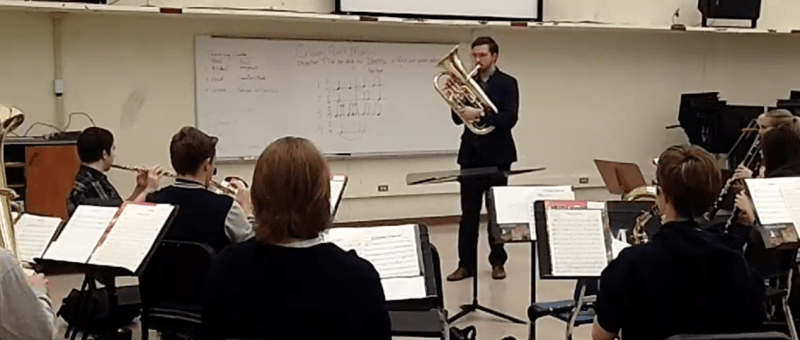
In the classroom, the students are given a book on day one and it is required materials throughout the semester long process. I believe that my IMT finds developing aural skills to be very important, but she feels like she is not able to use the process that is best for students because of time constraints. By the time they leave elementary school, they need to be able to know their fingerings, slide positions, rudiments, know basic musical ideas, and onto of it all: they have to read music. It is a must. Unfortunately for the students they only have thirty minutes of band twice a week. This overwhelming amount of things to do in such a short time means something must go, and it appears that developing aural skills is what has left the priorities list.
Student’s Voice:
I find that many students are advanced in their ability to recognize and match pitch. The percussionist I work with at my internship school do no like to read music and have leaned on figuring out mallet parts by ear. The trumpet players have also resorted to similar methods. The classroom teacher does not approach teaching with the Gordon model, so when I use this model with the students it takes them some getting used to. From what I have observed, the students enjoy it, but I can not tell if it is because it is something different, or they are enjoying the challenge of developing their oral skills. Another observation from these skills is that student mastery of the musical concepts increased, when using the gordon model. This experience reminds me a lot of my time in elementary band. Too many students, with not enough time to teach all of the necessary concepts to all of the students. It is clear that some student’s have been overlooked. With sixty something students and only one teacher who has limited time this is bound to happen, regardless what method the teacher is using.
IMT’s voice:
My intern mentor teacher, Michelle Kalo thinks that developing her students aural skills is extremely important, but as I suspected, she feels like there is simply too many other things that she has to get done in so little time. This is a sentiment that she says many of her colleagues in her district share. She also feels like it is more important that her students are able to read notes and rhythms than be able to play things by ear. When asked if there way a way to add more time to band class, she answered that her hand are tied because of the Mesa Unified School districts elementary band format. Until this is changed, she does not feel like she will be able to work more on students aural skills. This attitude toward aural skills is matched during band class as well. Students will pull out their instruments, begin to warm up on there own. Announcements are given and then students open the book to a group warm up, followed by the music they will be working on that day. In what feels like the blink of an eye, it feels like the class period is over.
Your Voice:
Developing aural skills in students is very important, and I believe that it should be the foundation to every musical education. I find it fascinating that this idea can be found in the Gordon, Kodaly, and Orff methods. I hope that in my class I will be able to use all of these methods and combine them into a method of my own. This method would begin with singing. Being active in both choral and instrumental music, I have personally seen the benefit that quality choral instruction has had on my own playing. I believe that once my students can sing through the musical idea aloud that it is an easy transfer to the instrument, especially with regard to brass playing. This is my hope, but I fear that if I am placed in a school like my current internship school I will fall into the same routine as my intern teacher. Simply put, there is no way to create a quality beginning band program with the students meeting two times a week for thirty minutes, no matter who the teacher is. In an ideal world, this would not be the case and my students will be both musically and aurally literate.


 Jake White