Music In Worship

Music in Worship is at a crossroads, and has been for sometime. In music history I wrote research paper on the writings of Martin Luther, and his views on music in worship. Below are some solutions I put forth. I invite your thoughts.

There is no good answer to the issues facing music in worship today. Both common performance mediums (Traditional and Contemporary Styles) have their positives and negatives. Some of these issues could be solved by a comprehensive music education for all people, but in the Untied States, that simply won’t happen for the time being. What is a solution to this issue that clergy could implement right now?

  1. Do not be afraid to teach the music to the congregation. If the melody is taught by rote, four measures at a time, it allows the congregation to get the pitch changes, and also spend more time with the lyrics and message of the song. If led by the clergy of the church, this can also provide a different type of connection to the members of the congregation, then can be found from preaching behind the pulpit.
  2. Offer classes. Many churches already offer out of service classes about many topics of spiritual importance.Why shouldn’t music be one of them? Offering classes on how to read hymns, or music in general would create a ministry opportunity that hasn’t been seen before. This can provide an entirely different ministry that is lacking from almost all churches, can help prevent people from being alienated by the hymn book, and allow clergy to connect to an entirely different group of congregants. (It might even help recruit people for the choir. 
  3. Ask your congregation. The type of music that they like is important in order for them to connect to the music. Ask the congregation the type of music they prefer and see if you can incorporate this into the musical worship.
  4. Use accompaniment appropriate for the song. Do not be afraid to use a guitar for one song, an organ for another, or a flute for the next. A great example of this would be to compare to songs that are popular in my own church.
    1. The first hymn,“O’ For a Thousand Tongues” by Charles Wesley, was written to be accompanied by Organ or Piano, so using this accompaniment would be appropriate to the context it was written. 
    2. The second hymn, “Shine Jesus Shine” was written for a praise band accompaniment, so using the church organ to accompany this song would not be appropriate. In this case, leading the congregation with a guitar or jazz piano would make much more sense.
  1. Make it fun. In his letter to the Church at Wittenberg, Luther writes  “… taking care lest the people should either be bored by too much repetition.” Luther wants the congregation to be interested in the music. Part of the way he made this happen was to include many types of music in his services. By making the music fun and enjoyable for the congregation to sing, the chances for congregants to connect to the spirituality of the song improves exponentially.

Conclusion

One of the key points of the reformation, started by Luther, is that there should be no secret to spiritual connection. This connection is for all people, not just the rich or the clergy. Music helps to create this connection and should be encouraged in all settings of worship. In Luther’s favorite scripture, Psalm 96, it states to “Sing unto the lord a new song. All the Earth.” It is far past time that music in worship started to sing a new song. A song that encourages all people in worship to sing along, not just the trained musicians. How that happens will have to be decided at each congregation. I hope that in my own church congregation we can begin to expand the congregational music making, and help people connect to the spirit they are called to. 
Teaching at Fee’s Middle School: Video

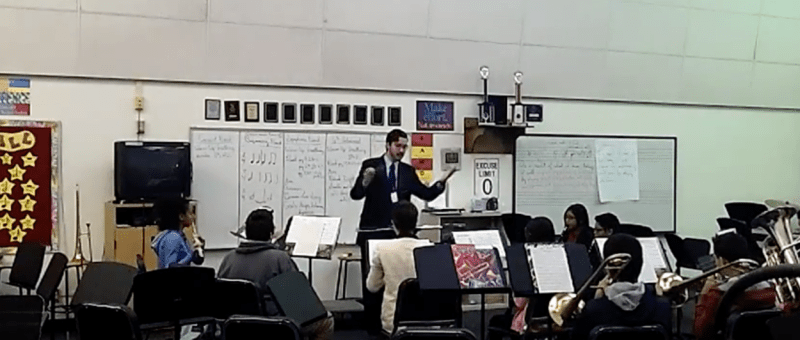
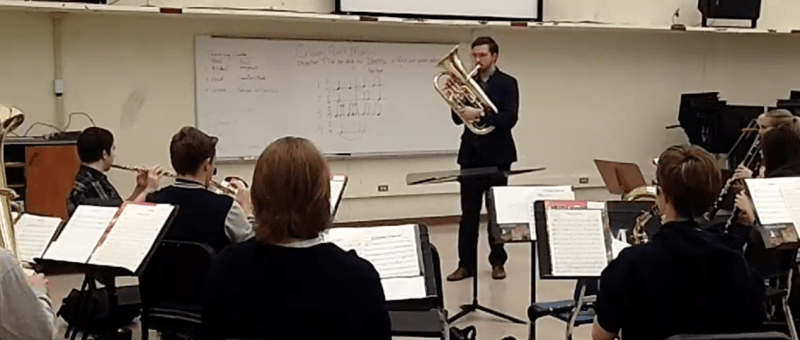
I loved the experience of teaching at Fees and knew that this was the career path for me. The first is a positive energy. At fees, the students were non-communicative and reluctant to be involved (which is understandable with an unfamiliar face in front) but as the instruction time went on, they relaxed and their energy changed. Upon my reflection at fees I noticed that student musical achievement was low and I do not know what I could have done in that situation to raise it. For example: the two trumpet players did not know how to play a “G” which is important to that piece of music. When I realized they were not playing in the appropriate parcel I attempted to work with them by having them sing the note, play the note, and I even asked an ASU student to sit by them and play with them. Even with all of this they still could not achieve this goal. I was faced with a choice, spend all my time on this group of students, or follow through the lesson: I chose the lesson. Lucky for me the primary goal was to define and identify a first and second ending. The students were able to achieve this objective and it was demonstrated by their ability to return to repeat sign.

My personal objective for this lesson was to “talk less and play more”. I would say that I mastered 50% of this goal. My instructions were clear a majority of the time, but when I was explaining the students fingering while I played spent 32 seconds explaining the directions, when I could have probably said, “Please finger and wind, but don’t make any sound” and that was it. This would have given more time for students to practice playing this piece, rather than being cut off with only the first four measures being played. Along these same lines I noticed that I said “Um” more than a few times and I have being trying for a very long time to quit saying this word.


This experience did have quite a few positives/ strengths as well. The first is my ability to make students feel welcome. I feel like it sounds silly, but by asking the students name, they all smiled and it felt as though they were more encouraged to answer the questions. I believe that names hold and incredible power that many people do not harness in the music world. This took time out of the lesson itself, but I believe that it was time well spent. The second strength that I had was I did my best to not put students on the spot. It was hard because of the small class numbers, but even when I was working with the clarinet section and having them play one at a time, I never gave constructive feedback allowed to the whole group, only to the clarinets. The final strength that is demonstrated is ENERGY. I told a joke, I had the students say random things, and I rewarded students with something as simple as a high-five, but that improved the students attitude and freed up the sound production.

I was grateful that my objective for this lesson was easy and simple. I believe that it helped set myself up for success with the students, especially because their achievement level was lower than (I feel like) we were told they would be. The process we were taught works, but it is not a process that works the first time like I thought it would. Looking back, teaching in class was not beneficial for me because I was already a strong teacher in my foundations. The stuff that went wrong at Fees Middle School were things that were caused by students not being able to play well yet. I feel like I was able to overcome these things, but I know that other students were not. For next semester my personal goals are to be able to teach a beginner with every instrument, and to learn two more secondary instruments. Preferably horn and flute.

In conclusion, I believe that the final teaching at fees was successful for myself. This was a learning experience for what I need to work on personally and how to proceed in future art of teaching classes.

Music In Worship

Music in Worship is at a crossroads, and has been for sometime. In music history I wrote research paper on the writings of Martin Luther, and his views on music in worship. Below are some solutions I put forth. I invite your thoughts.

There is no good answer to the issues facing music in worship today. Both common performance mediums (Traditional and Contemporary Styles) have their positives and negatives. Some of these issues could be solved by a comprehensive music education for all people, but in the Untied States, that simply won’t happen for the time being. What is a solution to this issue that clergy could implement right now?

  1. Do not be afraid to teach the music to the congregation. If the melody is taught by rote, four measures at a time, it allows the congregation to get the pitch changes, and also spend more time with the lyrics and message of the song. If led by the clergy of the church, this can also provide a different type of connection to the members of the congregation, then can be found from preaching behind the pulpit.
  2. Offer classes. Many churches already offer out of service classes about many topics of spiritual importance.Why shouldn’t music be one of them? Offering classes on how to read hymns, or music in general would create a ministry opportunity that hasn’t been seen before. This can provide an entirely different ministry that is lacking from almost all churches, can help prevent people from being alienated by the hymn book, and allow clergy to connect to an entirely different group of congregants. (It might even help recruit people for the choir. 
  3. Ask your congregation. The type of music that they like is important in order for them to connect to the music. Ask the congregation the type of music they prefer and see if you can incorporate this into the musical worship.
  4. Use accompaniment appropriate for the song. Do not be afraid to use a guitar for one song, an organ for another, or a flute for the next. A great example of this would be to compare to songs that are popular in my own church.
    1. The first hymn,“O’ For a Thousand Tongues” by Charles Wesley, was written to be accompanied by Organ or Piano, so using this accompaniment would be appropriate to the context it was written. 
    2. The second hymn, “Shine Jesus Shine” was written for a praise band accompaniment, so using the church organ to accompany this song would not be appropriate. In this case, leading the congregation with a guitar or jazz piano would make much more sense.
  1. Make it fun. In his letter to the Church at Wittenberg, Luther writes  “… taking care lest the people should either be bored by too much repetition.” Luther wants the congregation to be interested in the music. Part of the way he made this happen was to include many types of music in his services. By making the music fun and enjoyable for the congregation to sing, the chances for congregants to connect to the spirituality of the song improves exponentially.

Conclusion

One of the key points of the reformation, started by Luther, is that there should be no secret to spiritual connection. This connection is for all people, not just the rich or the clergy. Music helps to create this connection and should be encouraged in all settings of worship. In Luther’s favorite scripture, Psalm 96, it states to “Sing unto the lord a new song. All the Earth.” It is far past time that music in worship started to sing a new song. A song that encourages all people in worship to sing along, not just the trained musicians. How that happens will have to be decided at each congregation. I hope that in my own church congregation we can begin to expand the congregational music making, and help people connect to the spirit they are called to. 
Dayspring Youth Choir

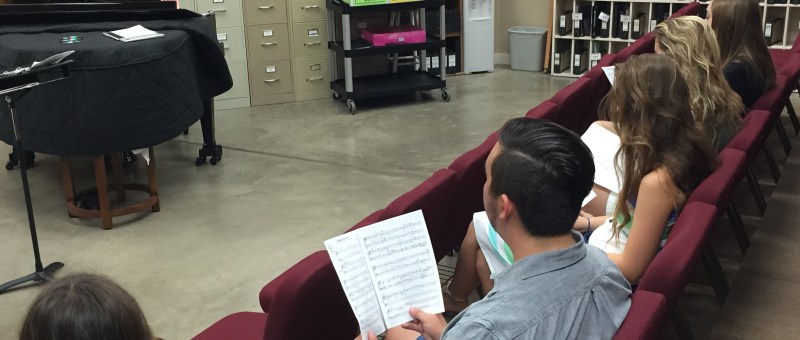
The first day of Dayspring Youth Choir was incredible. Thank you to everybody that came to the first rehearsal. Today we started to learn two pieces and set goals for our journey this year. First, we want to have fun. Music is exciting and brings people together, and we hope to capture that in our time together. Members of our ensemble come from differing musical experiences. By the end of our time together this year we hope to learn how to read music, and other basic musical skills. We want to be able to take this knowledge aIMG_6915nd be able to apply this knowledge in our future. Lastly, we hope to sing advanced music. This will come with time, and we hope that as we gain more members, our musical repertoire can increase in difficulty.

For next week, try to bring two friends with you to youth choir. Also, our ensemble needs a new name. Dayspring Youth Choir is ok, but it doesn’t have a great ring to it. Come to choir next Sunday with fun names in mind. Don’t forget, if you can talk you can sing. See you next week at 11:15 in the choir room.